
Leetcode Array & String
560. Subarray Sum Equals K
Description
Given an array of integers nums and an integer k, return the total number of subarrays whose sum equals k.
Click to view full description
Example 1:
- Input:
nums = [1,1,1], k = 2 - Output:
2
Example 2:
- Input:
nums = [1,2,3], k = 3 - Output:
2
Solution
Idea: 使用前缀和,遍历数组,计算当前前缀和与 k 的差值,如果差值在哈希表中,则说明存在一个子数组,其和为 k。
若某个区间 [i, j] 的和为 k,则满足 pre_sum[j] - pre_sum[i - 1] = k,即 pre_sum[j] - k = pre_sum[i - 1]。
Complexity: Time: O(n), Space: O(n)
1 | class Solution: |
56. Merge Intervals
Description
Given an array of intervals where intervals[i] = [start_i, end_i], merge all overlapping intervals, and return an array of the non-overlapping intervals that cover all the intervals in the input.
Click to view full description
Example 1:
- Input:
intervals = [[1, 3], [2, 6], [8, 10], [15, 18]] - Output:
[[1, 6], [8, 10], [15, 18]]
Example 2:
- Input:
intervals = [[1, 4], [4, 5]] - Output:
[[1, 5]]
Solution
Idea: 先对 intervals 进行排序,然后遍历 intervals,如果当前区间的 start 小于等于结果集中最后一个区间的 end,则将当前区间与结果集中最后一个区间合并,并更新结果集中最后一个区间的 end。否则,将当前区间加入结果集。
Complexity: Time: _O(n log n)_,Space: O(log n)
1 | class Solution: |
189. Rotate Array
Description
Given an integer array nums, rotate the array to the right by k steps, where k is non-negative.
Click to view full description
Example 1:
- Input:
nums = [1, 2, 3, 4, 5, 6, 7], k = 3 - Output:
[5, 6, 7, 1, 2, 3, 4]
Example 2:
- Input:
nums = [-1, -100, 3, 99], k = 2 - Output:
[3, 99, -1, -100]
Solution
Approach 1 切片
Idea: 这道题的本质是数组旋转,直觉上很容易想到将数组分成两部分,然后拼接起来。但这样需要额外空间,不是最优解。
Complexity: Time: O(n), Space: O(n)
1 | class Solution(object): |
Approach 2 数组翻转
Idea: 可以通过三次翻转来实现题目要求,首先将整个数组翻转,然后翻转前 k 个元素,最后翻转剩下的元素。
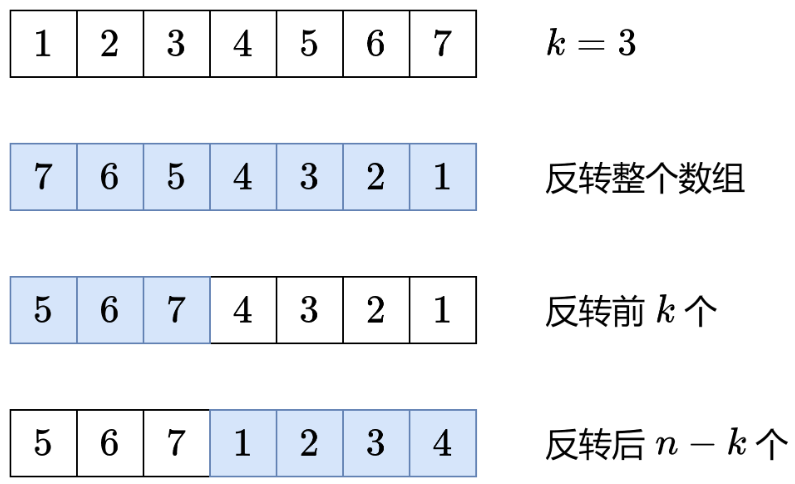
Complexity: Time: O(n), Space: O(1)
1 | class Solution(object): |
238. Product of Array Except Self
Description
Given an integer array nums, return an array answer such that answer[i] is equal to the product of all the elements of nums except nums[i].
The product of any prefix or suffix of nums is guaranteed to fit in a 32-bit integer.
You must write an algorithm that runs in O(n) time and without using the division operation.
Click to view full description
Example 1:
- Input:
nums = [1, 2, 3, 4] - Output:
[24, 12, 8, 6]
Example 2:
- Input:
nums = [-1, 1, 0, -3, 3] - Output:
[0, 0, 9, 0, 0]
Solution
Approach 1: 前缀积和后缀积
Idea: 我们不必将所有数字的乘积除以给定索引处的数字得到相应的答案,而是利用索引 左侧所有数字的乘积 和 右侧所有数字的乘积(即前缀与后缀)相乘得到答案。
Complexity: Time: O(n), Space: O(n)
1 | class Solution(object): |
Approach 2: 空间优化
Idea: 我们可以直接将答案数组作为前缀数组,这样我们就可以省略额外的空间。
Complexity: Time: O(n), Space: O(1)
1 | class Solution(object): |
Top Interview 150 补充
88. Merge Sorted Array
Description
You are given two sorted integer arrays nums1 and nums2, and two integers m and n representing the number of elements in each array. Your task is to merge these arrays into a single sorted array.
Click to view full description
The merged result should be stored in nums1, which has enough space to hold all elements. The initial extra space in nums1 is represented by 0s and should be ignored during the merge.
Example 1:
- Input:
nums1 = [1, 2, 3, 0, 0, 0], m = 3,nums2 = [2, 5, 6], n = 3 - Output:
[1, 2, 2, 3, 5, 6]
Example 2:
- Input:
nums1 = [1], m = 1,nums2 = [], n = 0 - Output:
[1]
Solution
Idea: 双指针是数组问题中常用的技巧。本题中,我们使用两个指针分别指向 nums1 和 nums2 的末尾,然后从后往前遍历,将较大的元素插入到 nums1 的末尾。本题的难点在于需要从后往前遍历,因为 nums1 的末尾是 0,我们需要将较大的元素插入到 nums1 的末尾,这样就不会覆盖 nums1 原有的元素。
Complexity: Time: O(m + n), Space: O(1)
1 | class Solution(object): |
27. Remove Element
Description
Given an integer array nums and an integer val, remove all occurrences of val in nums in-place. The order of the elements may be changed. Then return the number of elements in nums which are not equal to val.
Click to view full description
Change the array nums such that the first k elements of nums contain the elements which are not equal to val. The remaining elements of nums are not important as well as the size of nums.
Return k.
Example 1:
- Input:
nums = [3, 2, 2, 3],val = 3 - Output:
2,nums = [2, 2, _, _]
Example 2:
- Input:
nums = [0, 1, 2, 2, 3, 0, 4, 2],val = 2 - Output:
5,nums = [0, 1, 4, 0, 3, _, _, _]
Solution
Idea: 经典双指针问题。
Complexity: Time: O(n), Space: O(1)
1 | class Solution(object): |
26. Remove Duplicates from Sorted Array
Description
Given an integer array nums sorted in non-decreasing order, remove the duplicates in-place such that each unique element appears only once. The relative order of the elements should be kept the same. Then return the number of unique elements in nums.
Click to view full description
Change the array nums such that the first k elements of nums contain the elements which are not equal to val. The remaining elements of nums are not important as well as the size of nums.
Return k.
Example 1:
- Input:
nums = [1, 1, 2] - Output:
2,nums = [1, 2, _]
Example 2:
- Input:
nums = [0, 0, 1, 1, 1, 2, 2, 3, 3, 4] - Output:
5,nums = [0, 1, 2, 3, 4, _, _, _, _, _]
Solution
Idea: 经典双指针问题。
Complexity: Time: O(n), Space: O(1)
1 | class Solution(object): |
80. Remove Duplicates from Sorted Array II
Description
Given an integer array nums sorted in non-decreasing order, remove some duplicates in-place such that each unique element appears at most twice. The relative order of the elements should be kept the same.
Click to view full description
Change the array nums such that the first k elements of nums contain the elements which are not equal to val. The remaining elements of nums are not important as well as the size of nums.
Return k.
Example 1:
- Input:
nums = [1, 1, 1, 2, 2, 3] - Output:
5,nums = [1, 1, 2, 2, 3, _]
Example 2:
- Input:
nums = [0, 0, 1, 1, 1, 1, 2, 3, 3] - Output:
7,nums = [0, 0, 1, 1, 2, 3, 3, _, _]
Solution
Idea: 经典双指针问题,区别在于判断条件,要想明白快指针和谁比较。
Complexity: Time: O(n), Space: O(1)
1 | class Solution(object): |
169. Majority Element
Description
Given an array nums of size n, return the majority element.
The majority element is the element that appears more than ⌊n / 2⌋ times. You may assume that the majority element always exists in the array.
Click to view full description
Example 1:
- Input:
nums = [3, 2, 3] - Output:
3
Example 2:
- Input:
nums = [2, 2, 1, 1, 1, 2, 2] - Output:
2
Solution
Approach 1: 哈希表
Idea: 这道题直觉上很容易想到哈希表,用哈希表统计每个元素出现的次数,然后遍历哈希表,找到出现次数大于 n // 2 的元素。创建字典时 defaultdict 的用法值得积累。
Complexity: Time: O(n), Space: O(n)
1 | class Solution: |
Approach 2: 摩尔投票法
Idea: 摩尔投票法是一种高效的算法,用于解决寻找多数元素的问题,是本题的最优解。它的核心思想是通过不断消除不相同的元素,最终剩下的元素就是多数元素。当 count 为 0 时,candidate 更新为当前元素。然后继续遍历,如果当前元素和 candidate 相同,count 加 1,否则 count 减 1。最后剩下的 candidate 就是多数元素。
Complexity: Time: O(n), Space: O(1)
1 | class Solution(object): |
274. H-Index
Description
Given an array of integers citations where citations[i] is the number of citations a researcher received for their ith paper, return the researcher’s h-index.
According to the definition of h-index on Wikipedia: A scientist has an index h if h of their n papers have at least h citations each, and the other n - h papers have no more than h citations each.
If there are several possible values for h, the maximum one is taken as the h-index.
Click to view full description
Example 1:
- Input:
citations = [3, 0, 6, 1, 5] - Output:
3
Example 2:
- Input:
citations = [1, 3, 1] - Output:
1
Solution
Approach 1: 排序
Idea: 将数组从大到小排序后,遍历找到第一个满足条件的 h。根据 H 指数的定义,如果当前 H 指数为 h 并且在遍历过程中找到当前值 citations[i] > h,则说明我们找到了一篇被引用了至少 h+1 次的论文,所以将现有的 h 值加 1。继续遍历直到 h 无法继续增大。最后返回 h 作为最终答案。
Complexity: Time: O(n log n), Space: O(log n), 即为排序的时间和空间复杂度。
1 | class Solution(object): |
Approach 2: 计数排序
Idea: 根据上述解法我们发现,最终的时间复杂度与排序算法的时间复杂度有关,所以我们可以使用计数排序算法,新建并维护一个数组 counter 用来记录当前引用次数的论文有几篇。
根据定义,我们可以发现 H 指数不可能大于总的论文发表数,所以对于引用次数超过论文发表数的情况,我们可以将其按照总的论文发表数来计算即可。这样我们可以限制参与排序的数的大小为 [0,n](其中 n 为总的论文发表数),使得计数排序的时间复杂度降低到 O(n)。
最后我们可以从后向前遍历数组 counter,对于每个 0 ≤ i ≤ n,在数组 counter 中得到大于或等于当前引用次数 i 的总论文数。当我们找到一个 H 指数时跳出循环,并返回结果。
Complexity: Time: O(n), Space: O(n)
1 | class Solution(object): |
Approach 3: 二分查找
Idea: 我们需要找到一个值 h,它是满足有 h 篇论文的引用次数至少为 h 的 最大值。小于等于 h 的所有值 x 都满足这个性质,而大于 h 的值都不满足这个性质。所以这个问题可以用二分搜索来解决。
Complexity: Time: O(log n), Space: O(1)
1 | class Solution(object): |
380. Insert Delete GetRandom O(1)
Description
Implement the RandomizedSet class:
RandomizedSet()Initializes theRandomizedSetobject.bool insert(int val)Inserts an itemvalinto the set if not present, and returnstrueif the item was not present.bool remove(int val)Removes an itemvalfrom the set if present, and returnstrueif the item was present.int getRandom()Returns a random element from the current set of elements (it’s guaranteed that at least one element exists when this method is called). Each element must have the same probability of being returned.
You must implement the functions of the class such that each function works in average O(1) time complexity.
Click to view full description
Example 1:
- Input:
["RandomizedSet", "insert 1", "remove 2", "insert 2", "getRandom", "remove 1", "insert 2", "getRandom"] - Output:
[null, true, false, true, 2, true, false, 2]
Solution
Idea: 变长数组 + 哈希表。
变长数组可以在 O(1) 的时间内完成获取随机元素操作,但是由于无法在 O(1) 的时间内判断元素是否存在,因此不能在 O(1) 的时间内完成插入和删除操作。
哈希表可以在 O(1) 的时间内完成插入和删除操作,但是由于无法根据下标定位到特定元素,因此不能在 O(1) 的时间内完成获取随机元素操作。
为了满足插入、删除和获取随机元素操作的时间复杂度都是 O(1) ,需要将变长数组和哈希表结合,变长数组中存储元素,哈希表中存储每个元素在变长数组中的下标。哈希表存储元素的下标是为了确保删除的复杂度是 O(1) 。删除时将变长数组的最后一个元素移动到待删除元素的下标处,然后删除变长数组的最后一个元素。
Complexity: Time: O(1), Space: O(n)
1 | import random |
134. Gas Station
Description
There are n gas stations along a circular route, where the amount of gas at the ith station is gas[i].
You have a car with an unlimited gas tank and it costs cost[i] of gas to travel from the ith station to its next (i + 1)th station. You begin the journey with an empty tank at one of the gas stations.
Given two integer arrays gas and cost, return the starting gas station’s index if you can travel around the circuit once in the clockwise direction, otherwise return -1. If there exists a solution, it is guaranteed to be unique.
Click to view full description
Example 1:
- Input:
gas = [1, 2, 3, 4, 5], cost = [3, 4, 5, 1, 2] - Output:
3
Example 2:
- Input:
gas = [2, 3, 4], cost = [3, 4, 3] - Output:
-1
Solution
Idea: 我们可以将问题转化为一个折线图问题,其中 gas[i] 表示在第 i 个加油站的油量,cost[i] 表示从第 i 个加油站到第 i+1 个加油站的油量消耗。我们需要找到一个起点,使得从该起点出发,能够绕一圈回到起点,并且油量不会耗尽。
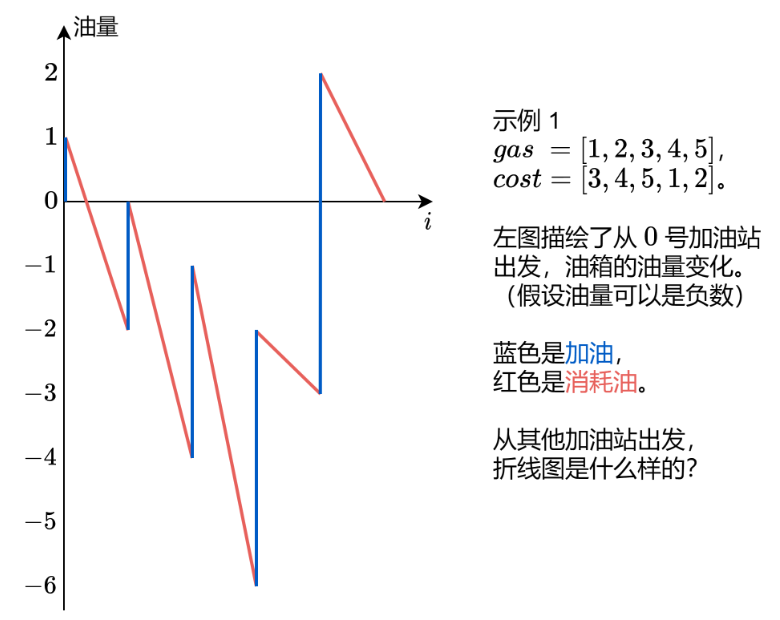
如果 gas 元素和大于等于 cost 元素和,则一定存在一个起点,使得从该起点出发,能够绕一圈回到起点,并且油量不会耗尽。该起点即为折线图中油量最低点(可以想象最低点和 X 轴的高度一致,则从最低点开始,油量一定不会耗尽)。
Complexity: Time: O(n), Space: O(1)
1 | class Solution(object): |
135. Candy
Description
There are n children standing in a line. Each child is assigned a rating value given in the integer array ratings.
You are giving candies to these children subjected to the following requirements:
- Each child must have at least one candy.
- Children with a higher rating get more candies than their neighbors.
Return the minimum number of candies you need to have to distribute to the children.
Click to view full description
Example 1:
- Input:
ratings = [1, 0, 2] - Output:
5
Example 2:
- Input:
ratings = [1, 2, 2] - Output:
4
Solution
Approach 1: 左右遍历
Idea: 我们可以从左到右遍历一次,确保每个孩子都比左边的孩子多一个糖果。然后从右到左遍历一次,确保每个孩子都比右边的孩子多一个糖果。最后遍历数组取最大值,就会同时满足左规则和右规则。
Complexity: Time: O(n), Space: O(n)
1 | class Solution(object): |
Approach 2: 常数空间遍历
Complexity: Time: O(n), Space: O(1)
这种解法比较难想,且不具有通用性,所以这里不做详细介绍。详细解法可以参考 官方题解。
13. Roman to Integer
Description
Roman numerals are represented by seven different symbols: I, V, X, L, C, D and M.
1 | Symbol Value |
For example, 2 is written as II in Roman numeral, just two ones added together. 12 is written as XII, which is simply X + II. The number 27 is written as XXVII, which is XX + V + II.
Roman numerals are usually written largest to smallest from left to right. However, the numeral for four is not IIII. Instead, the number four is written as IV. Because the one is before the five we subtract it making four. The same principle applies to the number nine, which is written as IX. There are six instances where subtraction is used:
Ican be placed beforeV(5) andX(10) to make 4 and 9.Xcan be placed beforeL(50) andC(100) to make 40 and 90.Ccan be placed beforeD(500) andM(1000) to make 400 and 900.
Given a roman numeral, convert it to an integer.
Click to view full description
Example 1:
- Input:
s = "III" - Output:
3
Example 2:
- Input:
s = "LVIII" - Output:
58
Example 3:
- Input:
s = "MCMXCIV" - Output:
1994
Solution
Idea: 使用一个字典来存储罗马数字和整数之间的映射关系,然后遍历字符串,根据当前字符和下一个字符的值来决定是加还是减。
Complexity: Time: O(n), Space: O(1)
1 | class Solution(object): |
12. Integer to Roman
Description
Seven different symbols represent Roman numerals with the following values:
1 | Symbol Value |
Roman numerals are formed by appending the conversions of decimal place values from highest to lowest. Converting a decimal place value into a Roman numeral has the following rules:
- If the value does not start with 4 or 9, select the symbol of the maximal value that can be subtracted from the input, append that symbol to the result, subtract its value, and convert the remainder to a Roman numeral.
- If the value starts with 4 or 9 use the subtractive form representing one symbol subtracted from the following symbol, for example, 4 is 1 (
I) less than 5 (V):IVand 9 is 1 (I) less than 10 (X):IX. Only the following subtractive forms are used:4(IV),9(IX),40(XL),90(XC),400(CD) and900(CM). - Only powers of 10 (
I,X,C,M) can be appended consecutively at most 3 times to represent multiples of 10. You cannot append 5 (V), 50 (L), or 500 (D) multiple times. If you need to append a symbol 4 times use the subtractive form.
Given an integer, convert it to a Roman numeral.
Click to view full description
Example 1:
- Input:
3749 - Output:
MMMDCCXLIX
Example 2:
- Input:
1994 - Output:
MCMXCIV
Solution
Idea: 从大到小依次处理千位、百位、十位和个位,根据当前位数的值选择合适的罗马数字符号并进行拼接。对 4 和 9 进行特殊处理。用一个变量remain来存储剩余的值,并逐步减去相应的值。
Complexity: Time: O(1), Space: O(1) 时间复杂度是常数,因为罗马数字的表示是有限的(1-3999)。
1 | class Solution(object): |
58. Length of Last Word
Description
Given a string s consisting of words and spaces, return the length of the last word in the string.
A word is a maximal substring consisting of non-space characters only.
Click to view full description
Example 1:
- Input:
s = "Hello World" - Output:
5
Example 2:
- Input:
s = " fly me to the moon " - Output:
4
Solution
Idea: 从后往前遍历字符串,找到最后一个单词的长度。用start来标记是否已经找到第一个非空字符。
Complexity: Time: O(n), Space: O(1)
1 | class Solution(object): |
14. Longest Common Prefix
Description
Write a function to find the longest common prefix string amongst an array of strings.
If there is no common prefix, return an empty string "".
Click to view full description
Example 1:
- Input:
["flower","flow","flight"] - Output:
"fl"
Example 2:
- Input:
["dog","racecar","car"] - Output:
""
Solution
Idea: 将第一个字符串假设为公共前缀,然后逐步检查它是否是所有字符串的公共前缀。如果不是,则将第一个字符串的长度减一,直到找到公共前缀。
Complexity: Time: O(mn), Space: O(1) 时间复杂度是 O(mn) 是因为每次比较两个字符串需要 O(n) 的时间,而需要比较 O(m) 次。m 是字符串的平均长度,n 是字符串的数量。
1 | class Solution(object): |
151. Reverse Words in a String
Description
Given an input string s, reverse the order of the words.
A word is defined as a sequence of non-space characters. The words in s will be separated by at least one space.
Return a string of the words in reverse order concatenated by a single space.
Note that s may contain leading or trailing spaces or multiple spaces between two words. The returned string should only have a single space separating the words. Do not include any extra spaces.
Click to view full description
Example 1:
- Input:
s = "the sky is blue" - Output:
"blue is sky the"
Example 2:
- Input:
s = " hello world " - Output:
"world hello"
Solution
Idea: 从后往前遍历字符串,将单词逐个添加到结果字符串中,并确保每个单词之间只有一个空格。最后检查是否还有没处理完的单词,如果有,则将其添加到结果字符串中。并且检查结果字符串的最后一个字符是否是空格,如果是,则将其删除。
Complexity: Time: O(n), Space: O(1)
1 | class Solution(object): |
6. Zigzag Conversion
Description
The string "PAYPALISHIRING" is written in a zigzag pattern on a given number of rows like this: (you may want to display this pattern in a fixed font for better legibility)
1 | P A H N |
And then read line by line: "PAHNAPLSIIGYIR"
Click to view full description
Example 1:
- Input:
s = "PAYPALISHIRING", numRows = 3 - Output:
"PAHNAPLSIIGYIR"
Example 2:
- Input:
s = "PAYPALISHIRING", numRows = 4 - Output:
"PINALSIGYAHRPI"
Solution
Idea: 将字符串按行分组,然后按行输出。用index来标记当前行,用increasing来标记当前行是正在增加还是减少。
Complexity: Time: O(n), Space: O(n)
1 | class Solution(object): |
28. Find the Index of the First Occurrence in a String
Description
Given two strings needle and haystack, return the index of the first occurrence of needle in haystack, or -1 if needle is not part of haystack.
Click to view full description
Example 1:
- Input:
haystack = "sadbutsad", needle = "sad" - Output:
0
Example 2:
- Input:
haystack = "leetcode", needle = "leeto" - Output:
-1
Solution
Approach 1: 暴力匹配
Idea: 让字符串 needle 与字符串 haystack 的所有长度为 m 的子串均匹配一次。
Complexity: Time: O(mn), Space: O(1)
1 | class Solution(object): |
Approach 2: KMP 算法
Idea: 首先构建部分匹配表(lps 数组),lps[i] 表示 needle[0:i+1] 的最长公共前后缀的长度,构建 lps 的时间复杂度为 _O(n)_。然后遍历 haystack,用 lps 数组来跳过不匹配的字符,时间复杂度为 _O(m)_。
这个方法理解起来有点复杂,我们举一个具体的例子来说明。
输入: haystack = "ababcabcabababd", needle = "ababd"
步骤 1:构建 lps 数组
(1)初始化 lps 数组,长度与 needle 相同,全为 0。
(2)遍历 needle[1:], 计算 lps 数组。
i = 1, 字符b != a,j = 0→lps[1] = 0。i = 2, 字符a == a,j = 1→lps[2] = 1。i = 3, 字符b == b,j = 2→lps[3] = 2。i = 4, 字符d != a,j = 0→lps[4] = 0。
| index | 0 | 1 | 2 | 3 | 4 |
|---|---|---|---|---|---|
| needle | a | b | a | b | d |
| lps | 0 | 0 | 1 | 2 | 0 |
步骤 2:匹配 haystack 和 needle
(1)初始化 i = 0, j = 0,表示当前匹配到 haystack 和 needle 的位置。
(2)遍历 haystack,用 lps 数组来跳过不匹配的字符。
i = 0,j = 0,haystack[0] == needle[0]→j = 1,i = 1i = 1,j = 1,haystack[1] == needle[1]→j = 2,i = 2i = 2,j = 2,haystack[2] == needle[2]→j = 3,i = 3i = 3,j = 3,haystack[3] == needle[3]→j = 4,i = 4i = 4,j = 4,haystack[4] != needle[4]→ 回退j = lps[3] = 2i = 4,j = 2,haystack[4] == needle[2]→j = 3,i = 5- …
最终在 i = 14, j = 5 时,haystack[10:15] == needle,返回 i - len(needle) + 1 = 10。
Complexity: Time: O(n+m), Space: O(n) n 是 needle 的长度,m 是 haystack 的长度。
加速的原因:
- 暴力匹配:每次匹配失败后,
needle的指针回到开头,haystack的指针回退,逐个字符重新匹配。 - KMP 算法:利用部分匹配表
lps跳过部分字符,needle的指针跳转到部分匹配的位置,haystack的指针继续前进。
1 | class Solution(object): |
228. Summary Ranges
Description
You are given a sorted unique integer array nums.
A range [a, b] is the set of all integers from a to b (inclusive).
Return the smallest sorted list of ranges that cover all the numbers in the array exactly. That is, each element of nums is covered by exactly one of the ranges, and there is no integer x such that x is in one of the ranges but not in nums.
Each range [a, b] in the list should be output as:
"a->b"ifa != b"a"ifa == b
Click to view full description
Example 1:
- Input:
nums = [0, 1, 2, 4, 5, 7] - Output:
["0->2", "4->5", "7"]
Example 2:
- Input:
nums = [0, 2, 3, 4, 6, 8, 9] - Output:
["0", "2->4", "6", "8->9"]
Solution
Idea: 遍历 nums,如果当前元素与前一个元素连续,则继续遍历。否则,根据范围的起点和终点(包含单个值或多个值),将范围加入 ans。最后需要处理最后一个范围。
Complexity: Time: O(n), Space: O(1)
1 | class Solution: |
57. Insert Interval
Description
You are given an array of non-overlapping intervals intervals where intervals[i] = [start_i, end_i] represent the start and the end of the i-th interval and intervals is sorted in ascending order by start_i. You are also given an interval newInterval = [start, end] that represents the start and end of another interval.
Insert newInterval into intervals such that intervals is still sorted in ascending order by start_i and intervals does not have any overlapping intervals (merge overlapping intervals if necessary).
Return intervals after the insertion.
Click to view full description
Example 1:
- Input:
intervals = [[1, 3], [6, 9]], newInterval = [2, 5] - Output:
[[1, 5], [6, 9]]
Example 2:
- Input:
intervals = [[1, 2], [3, 5], [6, 7], [8, 10], [12, 16]], newInterval = [4, 8] - Output:
[[1, 2], [3, 10], [12, 16]]
Solution
Idea: 遍历 intervals,如果当前区间的 end 小于 newInterval 的 start,则将当前区间加入 ans,并继续遍历。如果当前区间的 start 大于 newInterval 的 end,则将 newInterval 加入 ans,并将之后的区间直接加入 ans。否则,将 newInterval 与当前区间合并,并更新 newInterval。
Complexity: Time: O(n), Space: O(1)
1 | class Solution: |