
Leetcode Binary Tree
94. Binary Tree Inorder Traversal
Description
Given the root of a binary tree, return the inorder traversal of its nodes’ values.
Click to view full description
Example 1:
- Input:
root = [1,null,2,3] - Output:
[1,3,2]
Example 2:
- Input:
root = [] - Output:
[]
Solution
Idea: 使用递归的方法,分别计算左子树和右子树的遍历结果,然后合并。
Complexity: Time: O(n), Space: O(n)
1 | # Definition for a binary tree node. |
104. Maximum Depth of Binary Tree
Description
Given the root of a binary tree, return its maximum depth.
A binary tree’s maximum depth is the number of nodes along the longest path from the root node down to the farthest leaf node.
Click to view full description
Example 1:
- Input:
root = [3,9,20,null,null,15,7] - Output:
3
Example 2:
- Input:
root = [1,null,2] - Output:
2
Solution
Approach 1: 深度优先搜索
Idea: 使用递归的方法,分别计算左子树和右子树的最大深度,然后取两者中的最大值加 1 作为当前节点的最大深度。
Complexity: Time: O(n), Space: O(h)
1 | # Definition for a binary tree node. |
Approach 2: 广度优先搜索
Idea: 使用广度优先搜索的方法,遍历每一层节点,并记录深度。
Python 中使用 deque 来实现广度优先搜索。deque 是双端队列,可以高效地从两端进行插入和删除操作,时间复杂度为 _O(1)_。
Complexity: Time: O(n), Space: O(n)
1 | # Definition for a binary tree node. |
226. Invert Binary Tree
Description
Given the root of a binary tree, invert the tree, and return its root.
Click to view full description
Example 1:
- Input:
root = [4,2,7,1,3,6,9] - Output:
[4,7,2,9,6,3,1]
Example 2:
- Input:
root = [2,1,3] - Output:
[2,3,1]
Solution
Idea: 使用递归的方法,分别交换每个节点的左右子树。
Complexity: Time: O(n), Space: O(h)
1 | # Definition for a binary tree node. |
101. Symmetric Tree
Description
Given the root of a binary tree, check whether it is a mirror of itself (i.e., symmetric around its center).
Click to view full description
Example 1:
- Input:
root = [1,2,2,3,4,4,3] - Output:
true
Example 2:
- Input:
root = [1,2,2,null,3,null,3] - Output:
false
Solution
Idea: 使用递归的方法,分别比较两个子树是否对称, 递归地比较 左子树的左节点 和 右子树的右节点 以及 左子树的右节点 和 右子树的左节点。
Complexity: Time: O(n), Space: O(h)
1 | # Definition for a binary tree node. |
543. Diameter of Binary Tree
Description
Given the root of a binary tree, return the diameter of the tree.
The diameter of a binary tree is the length of the longest path between any two nodes in the tree. This path may or may not pass through the root.
The length of a path between two nodes is represented by the number of edges between them.
Click to view full description
Example 1:
- Input:
root = [1,2,3,4,5] - Output:
3
Example 2:
- Input:
root = [1,2] - Output:
1
Solution
Idea: 树的 直径 等于是某个节点的 左子树最大深度 + 右子树最大深度 之和。使用深度优先搜索的方法,计算每个节点的左右子树的最大深度,然后取两者中的最大值加 1 作为当前节点的最大深度返回。
Complexity: Time: O(n), Space: O(h)
1 | # Definition for a binary tree node. |
102. Binary Tree Level Order Traversal
Description
Given the root of a binary tree, return the level order traversal of its nodes’ values. (i.e., from left to right, level by level).
Click to view full description
Example 1:
- Input:
root = [3,9,20,null,null,15,7] - Output:
[[3],[9,20],[15,7]]
Example 2:
- Input:
root = [1] - Output:
[[1]]
Solution
Idea: 使用 BFS 从左到右遍历二叉树,每次将当前一层的所有节点的值加入结果列表中。用 level 来记录当前层的节点值。
Complexity: Time: O(n), Space: O(n)
1 | # Definition for a binary tree node. |
108. Convert Sorted Array to Binary Search Tree
Description
Given an integer array nums where the elements are sorted in ascending order, convert it to a height-balanced binary search tree.
Click to view full description
Example 1:
- Input:
nums = [-10,-3,0,5,9] - Output:
[0,-3,9,-10,null,5]
Example 2:
- Input:
nums = [1,3] - Output:
[3,1]
Solution
Idea: 使用递归的方法,将数组分成两部分,分别作为左右子树,然后递归地构建左右子树。
Complexity: Time: O(n), Space: O(log n)
1 | # Definition for a binary tree node. |
98. Validate Binary Search Tree
Description
Given the root of a binary tree, determine if it is a valid binary search tree (BST).
Click to view full description
Example 1:
- Input:
root = [2,1,3] - Output:
true
Example 2:
- Input:
root = [5,1,4,null,null,3,6] - Output:
false
Solution
Idea: 二叉搜索树的性质是左子树中的所有值小于根节点的值,右子树中的所有值大于根节点的值。使用递归,记录当前节点的值范围,如果当前节点的值不在范围之内,则返回 false。
Complexity: Time: O(n), Space: O(h)
1 | # Definition for a binary tree node. |
230. Kth Smallest Element in a BST
Description
Given the root of a binary search tree, and an integer k, return the kth smallest value (1-indexed) of all the values of the nodes in the tree.
Click to view full description
Example 1:
- Input:
root = [3,1,4,null,2], k = 1 - Output:
1
Example 2:
- Input:
root = [5,3,6,2,4,null,null,1], k = 3 - Output:
3
Solution
Idea: 使用中序遍历,记录当前遍历的节点数,当遍历到第 k 个节点时,返回该节点的值。因为二叉搜索树的性质,中序遍历的结果是升序的,所以第 k 个节点就是第 k 小的元素。
Complexity: Time: O(n), Space: O(h)
1 | # Definition for a binary tree node. |
199. Binary Tree Right Side View
Description
Given the root of a binary tree, imagine yourself standing on the right side of it, return the values of the nodes you can see ordered from top to bottom.
Click to view full description
Example 1:
- Input:
root = [1,2,3,null,5,null,4] - Output:
[1,3,4]
Example 2:
- Input:
root = [1,null,3] - Output:
[1,3]
Solution
Idea: 使用 BFS 从右到左遍历二叉树,每次将当前层的最后一个节点加入结果列表中。具体实现时,使用一个队列来存储当前层的节点,并使用一个变量来记录当前层的节点数。
Complexity: Time: O(n), Space: O(n)
1 | # Definition for a binary tree node. |
114. Flatten Binary Tree to Linked List
Description
Given the root of a binary tree, flatten the tree into a “linked list”:
- The “linked list” should use the same
TreeNodeclass where therightchild pointer points to the next node in the list and theleftchild pointer is alwaysnull. - The “linked list” should be in the same order as a pre-order traversal of the binary tree.
Click to view full description
Example 1:
- Input:
root = [1,2,5,3,4,null,6] - Output:
[1,null,2,null,3,null,4,null,5,null,6]
Example 2:
- Input:
root = [] - Output:
[]
Solution
Idea: 使用递归的方法,通过 前序遍历 将二叉树转换为 链表。然后遍历链表,将每个节点的 left 指针设置为 null,将每个节点的 right 指针设置为下一个节点。
Complexity: Time: O(n), Space: O(n)
1 | # Definition for a binary tree node. |
105. Construct Binary Tree from Preorder and Inorder Traversal
Description
Given two integer arrays preorder and inorder where preorder is the preorder traversal of a binary tree and inorder is the inorder traversal of the same tree, construct and return the binary tree.
Click to view full description
Example 1:
- Input:
preorder = [3,9,20,15,7], inorder = [9,3,15,20,7] - Output:
[3,9,20,null,null,15,7]
Example 2:
- Input:
preorder = [-1], inorder = [-1] - Output:
[-1]
Solution
Idea: 使用递归的方法,分别构建左子树和右子树。每次递归时,从 preorder 中取出第一个元素作为根节点,然后在中序遍历中找到根节点的位置 in_root,将中序遍历分为左右两部分,分别构建左子树和右子树。需要使用一个哈希表来存储中序遍历中每个元素的位置,以便快速找到根节点的位置(时间复杂度为 _O(1)_),这样可以使总时间复杂度从 O(n ^ 2) 降低到为 _O(n)_。
Complexity: Time: O(n), Space: O(n)
1 | # Definition for a binary tree node. |
437. Path Sum III
Description
Given the root of a binary tree and an integer targetSum, return the number of paths where the sum of the values along the path equals targetSum.
Click to view full description
Example 1:
- Input:
root = [10,5,-3,3,2,null,11,3,-2,null,1], targetSum = 8 - Output:
3
Example 2:
- Input:
root = [5,4,8,11,null,13,4,7,2,null,null,5,1], targetSum = 22 - Output:
3
Solution
Idea: 使用前缀和,遍历二叉树,计算当前路径的和。如果当前路径的和减去 targetSum 在哈希表中存在,则说明存在一条路径的和为 targetSum,计数器加一。注意在回溯时,需要将当前路径的和减去一,否则会重复计算。
Complexity: Time: O(n), Space: O(h)
1 | # Definition for a binary tree node. |
236. Lowest Common Ancestor of a Binary Tree
Description
Given a binary tree, find the lowest common ancestor (LCA) of two given nodes in the tree.
According to the definition of LCA on Wikipedia: “The lowest common ancestor is defined between two nodes p and q as the lowest node in T that has both p and q as descendants (where we allow a node to be a descendant of itself).”
Click to view full description
Example 1:
- Input:
root = [3,5,1,6,2,0,8,null,null,7,4], p = 5, q = 1 - Output:
3
Example 2:
- Input:
root = [3,5,1,6,2,0,8,null,null,7,4], p = 5, q = 4 - Output:
5
Solution
Idea: 使用递归。
递归的终止条件是:
- 当前节点为空,返回
False - 当前节点为
p或q,返回当前节点
递归过程:
- 递归左子树,找到左子树中是否存在
p或q - 递归右子树,找到右子树中是否存在
p或q - 如果左子树和右子树中分别存在
p或q,则当前节点为它们的公共祖先 - 如果左子树中存在
p或q,则返回左子树中的结果 - 如果右子树中存在
p或q,则返回右子树中的结果
Complexity: Time: O(n), Space: O(h)
1 | # Definition for a binary tree node. |
Top Interview 150 补充
100. Same Tree
Description
Given the roots of two binary trees p and q, write a function to check if they are the same or not.
Two binary trees are considered the same if they are structurally identical, and the nodes have the same value.
Click to view full description
Example 1:
- Input:
p = [1,2,3], q = [1,2,3] - Output:
true
Example 2:
- Input:
p = [1,2], q = [1,null,2] - Output:
false
Solution
Approach 1: 深度优先搜索
Idea: 使用递归的方法,分别比较两个树的根节点、左子树和右子树。
Complexity: Time: O(n), Space: O(h)
1 | # Definition for a binary tree node. |
Approach 2: 广度优先搜索
Idea: 用两个队列分别存储两个树的节点,然后依次比较两个队列中的节点。
Complexity: Time: O(n), Space: O(n)
1 | # Definition for a binary tree node. |
106. Construct Binary Tree from Inorder and Postorder Traversal
Description
Given two integer arrays inorder and postorder where inorder is the inorder traversal of a binary tree and postorder is the postorder traversal of the same tree, construct and return the binary tree.
Click to view full description
Example 1:
- Input:
inorder = [9,3,15,20,7], postorder = [9,15,7,20,3] - Output:
[3,9,20,null,null,15,7]
Example 2:
- Input:
inorder = [-1], postorder = [-1] - Output:
[-1]
Solution
Idea: 使用递归的方法,分别构建左子树和右子树。每次递归时,从 postorder 中取出最后一个元素作为根节点,然后在中序遍历中找到根节点的位置 in_root,将中序遍历分为左右两部分,分别构建左子树和右子树。需要使用一个哈希表来存储中序遍历中每个元素的位置,以便快速找到根节点的位置(时间复杂度为 _O(1)_),这样可以使总时间复杂度从 O(n ^ 2) 降低到为 _O(n)_。
Complexity: Time: O(n), Space: O(n)
1 | # Definition for a binary tree node. |
117. Populating Next Right Pointers in Each Node II
Description
Given a binary tree, populate each next pointer to point to its next right node. If there is no next right node, the next pointer should be set to NULL.
Initially, all next pointers are set to NULL.
Click to view full description
Example 1:
- Input:
root = [1,2,3,4,5,null,7] - Output:
[1,#,2,3,#,4,5,7,#]
Example 2:
- Input:
root = [] - Output:
[]
Solution
Idea: 使用迭代的方法,通过一个 dummy 节点来连接每一层的节点。每次迭代时,将 dummy 节点的 next 指向当前节点的左子节点或右子节点,然后将 dummy 节点指向 dummy.next,直到遍历完一层的所有节点。
Complexity: Time: O(n), Space: O(1)
1 | """ |
112. Path Sum
Description
Given the root of a binary tree and an integer targetSum, return true if the tree has a root-to-leaf path such that adding up all the values along the path equals targetSum.
A leaf is a node with no children.
Click to view full description
Example 1:
- Input:
root = [5,4,8,11,null,13,4,7,2,null,null,null,1], targetSum = 22 - Output:
true
Example 2:
- Input:
root = [1,2,3], targetSum = 5 - Output:
false
Solution
Idea: 使用递归的方法,如果当前节点是叶子节点,则判断当前节点的值是否等于 targetSum。如果当前节点不是叶子节点,则递归判断左子树或右子树中是否存在一条路径,使得路径上所有节点的值之和等于 targetSum - root.val。
Complexity: Time: O(n), Space: O(h)
1 | # Definition for a binary tree node. |
129. Sum Root to Leaf Numbers
Description
You are given the root of a binary tree containing digits from 0 to 9 only.
Each root-to-leaf path in the tree represents a number.
- For example, the root-to-leaf path
1 -> 2 -> 3represents the number123.
Return the total sum of all root-to-leaf numbers. Test cases are generated so that the answer will fit in a 32-bit integer.
A leaf node is a node with no children.
Click to view full description
Example 1:
- Input:
root = [1,2,3] - Output:
25
Example 2:
- Input:
root = [4,9,0,5,1] - Output:
1026
Solution
Idea: 使用递归的方法,每次将总和 total 乘以 10 再加上当前节点的值,如果当前节点是叶子节点,则返回总和 total,否则递归计算左子树和右子树的和。
Complexity: Time: O(n), Space: O(h)
1 | # Definition for a binary tree node. |
173. Binary Search Tree Iterator
Description
Implement the BSTIterator class that represents an iterator over the in-order traversal of a binary search tree (BST):
BSTIterator(root)Initializes an object of the class. The root of the BST is given as part of the constructor. The pointer should be initialized to a non-existent number smaller than any element in the BST.next()Returns the next smallest number.hasNext()Returnstrueif there exists a number in the iterator orfalseotherwise.
Click to view full description
Example 1:
- Input:
["BSTIterator", "next", "next", "hasNext", "next", "hasNext", "next", "hasNext", "next", "hasNext"],[root = [7, 3, 15, null, null, 9, 20]] - Output:
[null, 3, 7, true, 9, true, 15, true, 20, false]
Example 2:
- Input:
["BSTIterator", "next", "next", "hasNext", "next", "hasNext", "next", "hasNext", "next", "hasNext"],[root = [3, 1, 4, null, 2]] - Output:
[null, 1, 2, true, 3, true, 4, false]
Solution
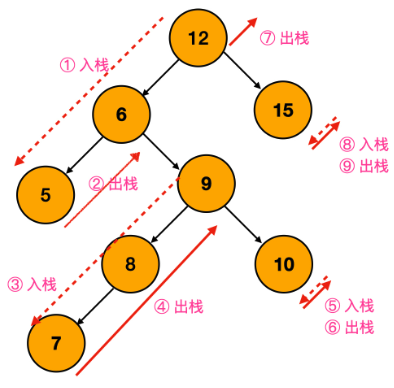
Idea: 使用栈来模拟中序遍历的过程。总体思路是 栈中只保留左节点。
初始化时,将根节点及其所有左子树的左节点压入栈中。每次 next() 时,从栈中弹出当前节点,并将当前节点的右节点及其所有左子树的左节点压入栈中。
Complexity: Time: O(1), Space: O(h)
1 | # Definition for a binary tree node. |
222. Count Complete Tree Nodes
Description
Given the root of a complete binary tree, return the number of the nodes in the tree.
According to Wikipedia, every level, except possibly the last, is completely filled in a complete binary tree, and all nodes in the last level are as far left as possible. It can have between 1 and 2^h nodes inclusive at the last level h.
Design an algorithm that runs in less than O(n) time complexity.
Click to view full description
Example 1:
- Input:
root = [1,2,3,4,5,6] - Output:
6
Example 2:
- Input:
root = [1,2,3,4,5,6,7,8,9,10,11,12,13,14,15] - Output:
15
Solution
Idea: 使用递归,完全二叉树的节点数等于左子树的节点数加上右子树的节点数再加上根节点。
Complexity: Time: O(n), Space: O(h)
1 | # Definition for a binary tree node. |
637. Average of Levels in Binary Tree
Description
Given the root of a binary tree, return the average value of the nodes on each level.
Click to view full description
Example 1:
- Input:
root = [3,9,20,null,null,15,7] - Output:
[3.00000,14.50000,11.00000]
Example 2:
- Input:
root = [3,9,20,15,7] - Output:
[3.00000,14.50000,11.00000]
Solution
Idea: 使用 BFS 从左到右遍历二叉树,每次将当前层的节点值累加,并计算平均值。具体实现时,使用一个队列来存储当前层的节点,并使用一个变量来记录这一层所有节点的值的总和。
Complexity: Time: O(n), Space: O(n)
1 | # Definition for a binary tree node. |
103. Binary Tree Zigzag Level Order Traversal
Description
Given the root of a binary tree, return the zigzag level order traversal of its nodes’ values. (i.e., from left to right, then right to left for the next level and alternate between).
Click to view full description
Example 1:
- Input:
root = [3,9,20,null,null,15,7] - Output:
[[3],[20,9],[15,7]]
Example 2:
- Input:
root = [1] - Output:
[[1]]
Solution
Idea: 使用 BFS 从左到右遍历二叉树,每次将当前一层的所有节点的值加入结果列表中。用 left_to_right 来记录当前层是从左到右还是从右到左。
Complexity: Time: O(n), Space: O(n)
1 | # Definition for a binary tree node. |
530. Minimum Absolute Difference in BST
Description
Given the root of a Binary Search Tree (BST), return the minimum absolute difference between the values of any two different nodes in the tree.
Click to view full description
Example 1:
- Input:
root = [4,2,6,1,3] - Output:
1
Example 2:
- Input:
root = [1,0,48,null,null,12,49] - Output:
1
Solution
Idea: 使用中序遍历,记录前一个节点的值,计算当前节点与前一个节点的差值,更新最小差值。
Complexity: Time: O(n), Space: O(h)
1 | # Definition for a binary tree node. |
二叉树问题总结
常见解题思路
递归(DFS)
- 最常用的解决二叉树问题的方法
- 适用于需要遍历整棵树的场景
- 主要遍历方式:
- 前序遍历(根-左-右)
- 中序遍历(左-根-右)
- 后序遍历(左-右-根)
迭代(BFS)
- 使用队列实现层序遍历
- 适用于需要按层处理节点的场景
- 常用数据结构:
deque(双端队列),可以实现时间复杂度为 O(1) 的插入和删除操作
分治法
- 将问题分解为左右子树的子问题
- 合并左右子树的结果
如何写出递归代码
确定递归函数的参数和返回值
1
2
3def recursion(root: TreeNode) -> Type:
# 函数参数要包含解决问题所需的所有信息
# 返回值要能够传递需要的信息给上层调用确定终止条件
1
2
3
4
5def recursion(root: TreeNode) -> Type:
if not root: # 最常见的终止条件
return specific_value
if other_condition: # 其他可能的终止条件
return other_value确定单层递归逻辑
1
2
3
4
5
6
7
8
9
10
11
12
13def recursion(root: TreeNode) -> Type:
if not root:
return specific_value
# 处理当前节点
result = process_current_node(root)
# 递归处理左右子树
left_result = recursion(root.left)
right_result = recursion(root.right)
# 整合结果
return combine_results(result, left_result, right_result)
解题技巧
使用哈希表优化查找
- 在树的构造问题中常用
- 可以将 O(n) 的查找优化为 O(1)
使用全局变量
- 在需要在递归过程中维护状态时使用
- 注意变量的重置时机
自顶向下 vs 自底向上
- 自顶向下:通过参数传递信息
- 自底向上:通过返回值传递信息
通过掌握这些模式和技巧,我们可以更系统地解决二叉树相关的问题。关键是要认识到大多数二叉树问题都可以通过递归来解决,而写好递归的关键在于:
- 明确递归函数的定义和功能
- 设置正确的终止条件
- 处理好当前层级的逻辑
- 正确地组合子问题的结果