
Leetcode Greedy Algorithm
121. Best Time to Buy and Sell Stock
Description
You are given an array prices where prices[i] is the price of a given stock on the i-th day.
You want to maximize your profit by choosing a single day to buy one stock and choosing a different day in the future to sell that stock.
Return the maximum profit you can achieve from this transaction. If you cannot achieve any profit, return 0.
Click to view full description
Example 1:
- Input:
prices = [7, 1, 5, 3, 6, 4] - Output:
5
Example 2:
- Input:
prices = [7, 6, 4, 3, 1] - Output:
0
Solution
Idea: 动态规划。这道题的本质是寻找数组中的最大差值。思路可以总结为如果某天卖出股票,则该天卖出的最大利润为该天的股价-前面天数中最小的股价,然后与已知的最大利润比较,如果大于则更新当前最大利润的值。
Complexity: Time: O(n), Space: O(1)
1 | class Solution(object): |
55. Jump Game
Description
You are given an integer array nums. You are initially positioned at the array’s first index, and each element in the array represents your maximum jump length at that position.
Return true if you can reach the last index, or false otherwise.
Click to view full description
Example 1:
- Input:
nums = [2, 3, 1, 1, 4] - Output:
true
Example 2:
- Input:
nums = [3, 2, 1, 0, 4] - Output:
false
Solution
Idea: 这道题的本质是判断数组中是否存在一个路径可以到达最后一个元素。可以采用贪心算法,不断更新能到达的最远位置。如果当前位置大于能到达的最远位置,则返回 false,否则更新能到达的最远位置。
Complexity: Time: O(n), Space: O(1)
1 | class Solution(object): |
45. Jump Game II
Description
You are given a 0-indexed array of integers nums of length n. You are initially positioned at nums[0].
Each element nums[i] represents the maximum length of a forward jump from index i. In other words, if you are at nums[i], you can jump to any nums[i + j] where:
0 <= j <= nums[i]i + j < n
Return the minimum number of jumps to reach nums[n - 1]. The test cases are generated such that you can reach nums[n - 1].
Click to view full description
Example 1:
- Input:
nums = [2, 3, 1, 1, 4] - Output:
2
Example 2:
- Input:
nums = [2, 3, 0, 1, 4] - Output:
2
Solution
Idea: 这道题的本质是寻找数组中到达最后一个元素的最小跳跃次数。可以采用贪心算法,将问题想象成搭桥过河,在可以选择的桥中,选择右端点最远的桥。本题的思路有些难懂,需要仔细思考每个变量的含义。
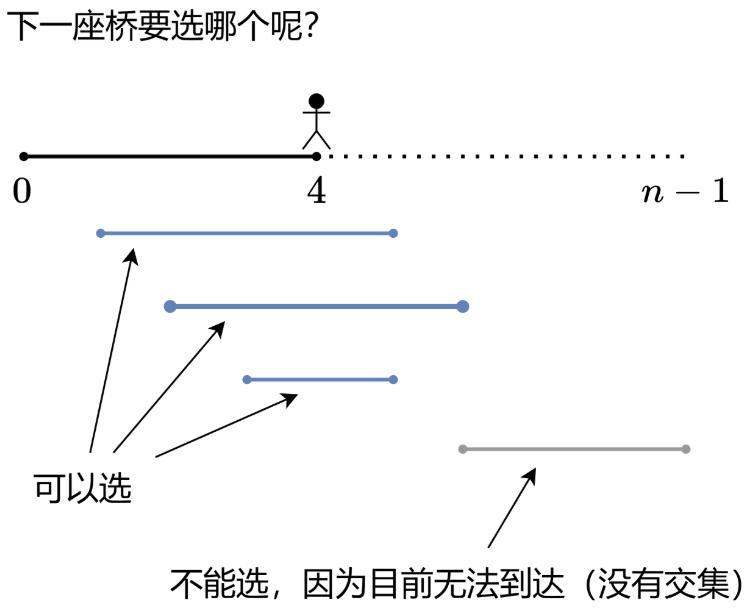
这里要注意一个细节,循环时 i 只循环到 n-2。因为开始的时候边界是第 0 个位置,steps 已经加 1 了,所以假如最后一步从 n-2 跳到 n-1,那么 steps 就不需要再加 1 了。所以如果 i 循环到 n-1,那么 steps 就会额外再加 1 导致出错。
Complexity: Time: O(n), Space: O(1)
1 | class Solution(object): |
763. Partition Labels
Description
You are given a string s. We want to partition the string into as many parts as possible so that each letter appears in at most one part.
Note that the partition is done so that after concatenating all the parts in order, the resultant string should be s.
Return a list of integers representing the size of these parts.
Click to view full description
Example 1:
- Input:
s = "ababcbacadefegdehijhklij" - Output:
[9, 7, 8]
Example 2:
- Input:
s = "eccbbbbdec" - Output:
[10]
Solution
Idea: 这道题的本质是寻找字符串中每个字符的最后一个位置,然后根据每个字符的最后一个位置将字符串分割成若干个部分。分隔时,end 是当前字符的最后一个位置,start 是当前字符的开始位置。当 i 等于 end 时,说明当前字符的最后一个位置已经确定,将 end - start + 1 加入结果列表,并更新 start 为 i + 1。
Complexity: Time: O(n), Space: O(n)
1 | class Solution: |
Top Interview 150 补充
53. Maximum Subarray
Description
Given an integer array nums, find the contiguous subarray (containing at least one number) which has the largest sum and return its sum.
Click to view full description
Example 1:
- Input:
nums = [-2,1,-3,4,-1,2,1,-5,4] - Output:
6
Example 2:
- Input:
nums = [1] - Output:
1
Solution
Idea: 使用贪心算法,要么继续累加当前元素,要么从当前元素开始重新累加。计算包含当前元素的最大连续子数组和 cur_sum,如果 cur_sum 小于当前元素,则更新 cur_sum 为当前元素,否则将当前元素加入 cur_sum。
Complexity: Time: O(n), Space: O(1)
1 | class Solution: |
122. Best Time to Buy and Sell Stock II
Description
You are given an integer array prices where prices[i] is the price of a given stock on the i-th day.
On each day, you may decide to buy and/or sell the stock. You can only hold at most one share of the stock at any time. However, you can buy it then immediately sell it on the same day.
Find and return the maximum profit you can achieve.
Click to view full description
Example 1:
- Input:
prices = [7, 1, 5, 3, 6, 4] - Output:
7
Example 2:
- Input:
prices = [1, 2, 3, 4, 5] - Output:
4
Example 3:
- Input:
prices = [7, 6, 4, 3, 1] - Output:
0
Solution
Idea: 贪心算法指每一步都做出局部最优解,从而达到全局最优解。这道题中具体指:所有上涨的交易日都进行交易(赚到所有可能的利润),所有下降的交易日都不进行交易(永远不亏钱)。这样这道题就可以简化为遍历数组,如果当前天数的价格大于前一天的价格,则将差值累加到最大利润中。
Complexity: Time: O(n), Space: O(1)
1 | class Solution(object): |
452. Minimum Number of Arrows to Burst Balloons
Description
There are some spherical balloons taped onto a flat wall that represents the XY-plane. The balloons are represented as a 2D integer array points where points[i] = [x_start, x_end] denotes a balloon whose horizontal diameter stretches between x_start and x_end. You do not know the exact y-coordinates of the balloons.
Arrows can be shot up directly vertically (in the positive y-direction) from different points along the x-axis. A balloon with x_start and x_end is burst by an arrow shot at x if x_start <= x <= x_end. There is no limit to the number of arrows that can be shot. A shot arrow keeps traveling up infinitely, bursting any balloons in its path.
Given the array points, return the minimum number of arrows that must be shot to burst all balloons.
Click to view full description
Example 1:
- Input:
points = [[1, 2], [3, 4], [5, 6], [7, 8]] - Output:
4
Example 2:
- Input:
points = [[1, 2], [2, 3], [3, 4], [4, 5]] - Output:
2
Solution
Idea: 先对 points 进行排序。然后使用贪心算法的思想,首先将第一个区间的 x_end 作为 shot,然后遍历 points。如果当前区间的 x_start 大于 shot,则说明之前的箭无法射中当前区间,需要射箭,射箭次数加一,并更新 shot 为当前区间的 x_end。
Complexity: Time: _O(n log n)_,Space: O(log n)
1 | class Solution: |